Complete Guide to Yamaha V6 Outboard Lower Units (2‑Stroke and 4‑Stroke)
April 24, 2026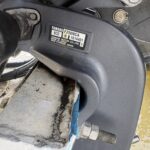
Yamaha F250NCA: Identify and Source the Correct Lower Unit
June 9, 2026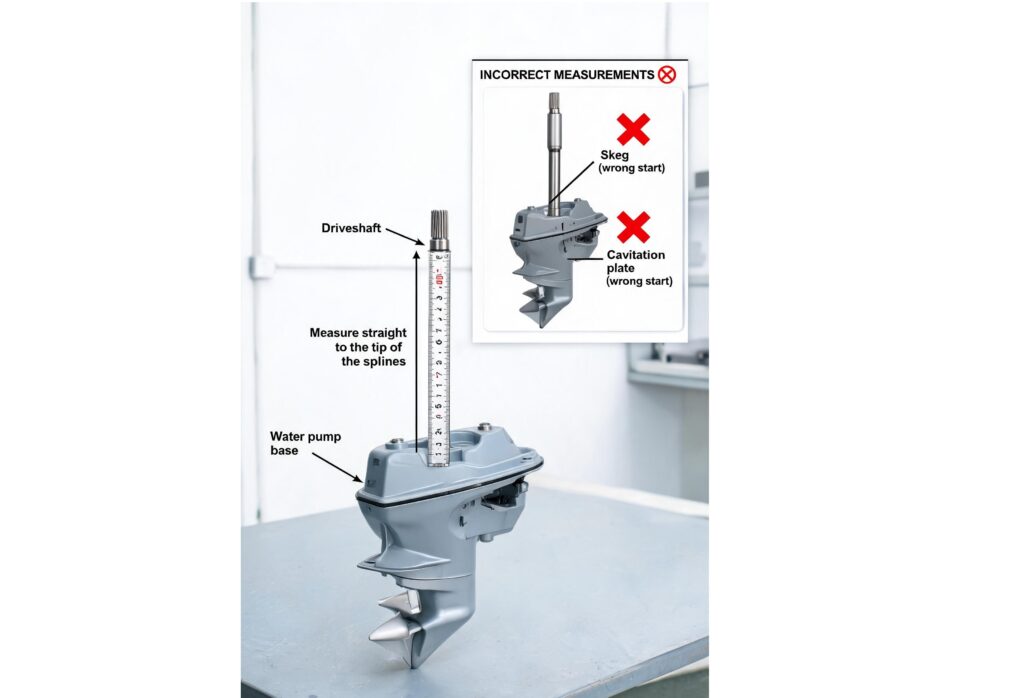
Quick summary
- “15, 20, 25, 30 inch” shaft lengths are nominal classes, not exact tape‑measure numbers.
- On Yamaha, the model code letter tells you shaft class:
- S = 15″ short
- L = 20″ long
- X = 25″ extra‑long
- U = 30″ ultra‑long
- When you physically measure a long‑shaft (20″) lower unit driveshaft from the water‑pump base to the top of the splines, you typically get around 23″, not 20″.
- Extra‑long (25″) driveshafts often measure around 28″ using the same method.
- Many “wrong shaft” complaints come from measuring from the wrong points (skeg, cavitation plate, etc.) or expecting the tape to read 20″/25″ exactly.
- A 5″ spacer/extension kit can convert a 20″ outboard to 25″ using a spacer housing and a 5″ stub driveshaft; this must be considered when ordering lower units and shafts.
What shaft length really means
When we talk about outboard shaft length—15″, 20″, 25″, 30″—we are talking about standard size classes, not the literal length of the internal driveshaft.
The nominal shaft length is based on the distance between the mounting bracket and the water surface/keel when the motor is mounted at the proper height on a matching transom. In practice, the actual metal driveshaft must pass through the mid‑section, water pump, and gearcase, so it ends up being several inches longer than the nominal number.
Manufacturers and dealers therefore classify shafts by the class they are closest to, rather than demanding an exact 15/20/25″ measurement.
Typical classes:
- Short shaft: nominal 15″
- Long shaft: nominal 20″
- Extra‑long: nominal 25″
- Ultra‑long: around 30″
Some manufacturers (for example Tohatsu) even state that their “long” shaft may measure about 22″ instead of 20″, again confirming that these are class ranges, not exact figures.
Model codes and shaft length (Yamaha and others)
Yamaha
Yamaha encodes shaft length in the model code itself. The key letters are:
- S – Short shaft, 15″
- L – Long shaft, 20″
- X – Extra‑long shaft, 25″
- U – Ultra‑long shaft, 30″
For example, a Yamaha four‑stroke model labeled with “L” in the code is a 20″ long‑shaft, and models with “X” are 25″ extra‑long from factory.
When choosing lower units and driveshafts for Yamaha, always start by checking the model label on the transom bracket and decoding that shaft‑length letter.
Other brands
Other brands use similar conventions:
- Mercury/Mariner use designations like “L” and “XL” to indicate long (20″) and extra‑long (25″) shafts, and they publish actual driveshaft measurements for those classes.
- Tohatsu, Honda, Suzuki and others also classify by short/long/extra‑long and specify recommended shaft lengths based on transom height ranges.
The important point: model code + transom height should always be your starting point, not a tape measure on a random point on the gearcase.
How to measure a driveshaft correctly (lower unit off the engine)
If you already have the lower unit off the engine and want to verify shaft length for ordering a replacement, use the method that gearcase rebuilders use.
Step‑by‑step method
- Remove the lower unit
Take the gearcase off the mid‑section so the driveshaft is exposed. - Stand the lower unit upright
Place it on blocks or the skeg so the driveshaft is vertical and the unit is stable. - Identify the water‑pump base
Look at the top of the gearcase where the water pump housing sits. You want the flat metal surface at the base of the pump plate, not the top of the plastic housing. - Measure along the driveshaft
Place the end of the tape at the water‑pump base and measure straight up along the shaft to the very tip of the splines.- Keep the tape parallel to the shaft.
- Do not follow any curves or angles.
- Classify the shaft length
Using the measurement from the pump base to the splined tip:
Southcentral Outboards, a major lower‑unit supplier, summarizes it this way: the shaft is never exactly 15/20/25″; whatever measurement falls closest to 15 is short, closest to 20 is long, closest to 25 is extra‑long, and so on.
What not to measure from
Common mistakes that lead to “wrong shaft” misunderstandings:
- Measuring from the bottom of the gearcase or skeg to the shaft tip.
- Measuring from the cavitation plate to the shaft tip and expecting 20 or 25 exactly.
- Measuring at an angle instead of along the centerline of the shaft.
All of these methods add or subtract several inches and will not line up with published driveshaft specs.
Real‑world measurement examples
Example: 20″ vs 25″ spec from manufacturer data
Mercury/Mariner publish a simple technical guide for measuring driveshafts:
- To obtain the driveshaft length, measure from the top of the gearcase housing (base of the water‑pump plate) to the top of the shaft.
- In that guide, they specify:
This lines up exactly with what many builders see in practice: a “20‑inch” long shaft outboard will have a driveshaft around 23″, and a “25‑inch” extra‑long shaft will have a driveshaft around 28″ when measured correctly.
Example: user measurement close to 23″ on a “20‑inch” unit
On a marine repair forum, an owner reported measuring a lower‑unit driveshaft from the driveshaft collar above the top bearing to the tip and found roughly 23 1/4″ on a unit that is sold and recognized as a “20‑inch” lower unit.
Again, this confirms that in the real world:
- Driveshaft around 23–23.5″ ⇒ 20″ long‑shaft class.
- Driveshaft around 28″ ⇒ 25″ extra‑long class.
If someone expects the tape to say “20 inches” exactly, a 23″ reading can easily create confusion and lead them to believe they needed a “25‑inch” shaft.
Measuring shaft length from the boat (transom method)
If the outboard is still on the boat—or you’re choosing a new engine—the standard way to pick shaft length is by transom height.
How to measure transom height
- Put the boat level on the trailer or in the water.
- Measure from the top of the transom, where the motor mounts, straight down to the bottom of the keel at the centerline.
- That vertical distance is your transom height.
Matching transom height to shaft length
Generic guidelines from multiple sources:
- Transom around 15″ → short‑shaft (15″) outboard.
- Transom around 20″ → long‑shaft (20″) outboard.
- Transom around 25″ → extra‑long (25″) outboard.
Tohatsu, for example, advises that if the transom measures 20–22″, you need their “long shaft”, and notes that some of their long shafts may measure about 22″ instead of 20″.
Videos and articles from dealers also recommend checking that the cavitation plate ends up roughly level with the bottom of the hull (the keel) when the motor is mounted; this is a good visual confirmation that you’ve matched shaft length to transom height correctly.
Spacers and 5″ extension kits
What a 5″ extension kit does
Many outboards can be converted from one shaft length to another (often 20″ to 25″) using a 5‑inch extension kit. These kits are offered by manufacturers and aftermarket companies such as Bay Manufacturing and Latham Marine.
A typical 5″ extension kit includes:
- A 5″ spacer housing that bolts between the mid‑section and the lower unit.
- A stub driveshaft extension, about 5″ long, that slides over the existing driveshaft.
- A longer shift shaft or shift coupler extension.
- A water‑tube extension and other hardware (studs, nuts, seals).
Bay Manufacturing describes their stub driveshaft as a 5″ extension piece with internal splines on the female end, designed to fit over the original driveshaft and extend it by exactly 5″ without replacing the full shaft.
Latham Marine offers Yamaha spacer kits that include a 5″ spacer block, extended driveshaft, water pickup extension, shift extension, and fittings, specifically to lower the propeller 5″ for high‑transom applications.
Why this matters when ordering lower units and shafts
If an engine has been modified with an extension kit:
- The model code might still indicate a 20″ shaft, but the motor effectively behaves like a 25″ setup.
- The driveshaft arrangement can be:
- A full‑length 25″ shaft, or
- A 20″ shaft plus a 5″ stub extension.
When ordering replacement lower units or driveshafts, you must know whether:
- The motor is stock (no spacer) and uses a standard shaft; or
- It has a 5″ spacer and stub shaft installed, in which case you may need a different configuration.
A quick visual inspection between the powerhead/midsection and the lower unit will usually reveal a spacer block if present, because the midsection will look “taller” and there will be an obvious extra casting between the midsection and gearcase.
Common causes of “wrong shaft” complaints
From the above, most “wrong driveshaft length” situations can be traced to a few patterns:
- Measuring from the wrong points
- Measuring from the skeg or cavitation plate rather than from the water‑pump base to the top of the splines.
- Measuring on the boat from arbitrary points instead of using the correct transom‑height method.
- Expecting exact 15/20/25″ numbers
- Owners expect a “20‑inch” shaft to measure exactly 20″, so when they see ~23″, they assume it must be a 25″ shaft.
- Manufacturer data from Mercury and others clearly shows that long shafts around 23″ and extra‑long around 28″ are normal.
- Hidden 5″ extension kits
- Previous owners may have installed a 5″ spacer kit and stub driveshaft but never changed the cowling decals or model labels.
- The transom may be a 25″ design while the model code indicates a 20″ class engine, or vice versa.
- Mixed parts or partial conversions
When diagnosing a complaint, it’s best practice to:
- Confirm the model code and its shaft letter.
- Measure the driveshaft from the water‑pump base to splined tip.
- Check the boat’s transom height.
- Look for any spacer blocks or extension kits between mid‑section and gearcase.
Once those four points are clear, it’s usually obvious whether the part is correct or not.
Final tips for techs and boat owners
- Always decode the model label first, especially on Yamaha and other brands that encode shaft length in the model code.
- Use the correct measurement method: water‑pump base to spline tip for driveshafts, and transom‑to‑keel for boats.
- Remember that a 20″ class shaft often measures about 23″, and a 25″ class about 28″—this is normal and backed by manufacturer specs and real‑world examples.
- Check for extension kits whenever the measured length or transom height doesn’t match the model code.
With these basics understood, most shaft‑length questions can be resolved quickly and accurately, and you can order or supply the correct lower unit the first time.
Prepared by Deep Research