
When a Yamaha outboard lower unit fails, many boat owners choose a new aftermarket lower unit instead of an expensive OEM gearcase. These replacement units are built by independent manufacturers, not by Yamaha, but they are engineered to match the original equipment (OE) specifications for your engine.
That means they are designed to bolt up correctly, shift smoothly, and cool the motor properly. At the same time, the external parts and castings on an aftermarket lower unit may look different from the factory gearcase you are replacing.
Same OE specs, different parts
A key idea customers must understand is this:
“Made to the same OE specs” does not mean “every part is physically identical to OEM.”
Aftermarket manufacturers follow Yamaha’s critical specifications for:
- Driveshaft length and spline count
- Gear ratio and gear set alignment
- Shift shaft geometry and engagement
- Water pump flow and cooling passages
These are the dimensions and tolerances that matter for fit, function, and reliability.yamahaoutboardparts+1
However, the castings, bolt styles, and covers are often redesigned by the aftermarket factory, even though the unit still meets Yamaha’s OE performance targets.
Why housings and covers look different
Customers often first notice differences around the water pump housing on top of the gearcase.
On a Yamaha lower unit, the pump assembly usually includes a cartridge or housing, an impeller, plates, O‑rings, and a cover held down with small bolts.
Aftermarket manufacturers may:
- Use a different shape or height for the pump cover
- Change the number or spacing of the cover bolts
- Cast the housing with different ribs and markings
GLM and other marine suppliers openly advertise aftermarket Yamaha water pump kits and housings that are compatible with multiple Yamaha HP ranges, yet clearly not identical to Yamaha’s original molds.
In other words, visual differences are normal, provided the internal dimensions, seals, and water flow match Yamaha’s engineering requirements.
Bolt patterns vs real compatibility
When a customer says, “The bolt pattern on your water pump cover is different than mine,” they are usually talking about the small bolts on the pump housing, not the main bolts that mount the lower unit to the midsection.
From a compatibility standpoint, the following matters most:
- The main mounting bolt pattern between the lower unit and the midsection
- Driveshaft fit into the crankshaft splines
- Shift shaft alignment and travel
- Water inlet and outlet alignment in the exhaust housing
As long as the lower unit bolts up to the midsection correctly and engages the engine properly, the gearcase is compatible even if the pump cover bolt pattern itself looks different.
Yamaha forums and cross‑reference guides confirm that many different part numbers and external castings are interchangeable across model years, even when they don’t look the same.yamahaoutboardparts+2
OEM vs aftermarket: interchangeability and design
Marine parts dealers often describe aftermarket lower units as “built new to manufacturer specifications with non‑OEM parts.”
That means:
- The unit is engineered around Yamaha’s OE specs
- All internal parts are new, but they are not Yamaha‑branded
- Many OEM parts and aftermarket parts are interchangeable, but not visually identicalyamahaoutboardparts+1
One Yamaha forum discussion about SEI and similar gearcases notes that they are “clones of OEM built to their specifications,” with OEM parts generally interchangeable.
This supports the message you want on your site: aftermarket does not mean “wrong fit,” it just means “different manufacturer and different looking parts.
New aftermarket lower units come with water pumps installed
A big benefit of buying a new aftermarket Yamaha lower unit is that it usually arrives complete with a brand‑new water pump already installed.
You are not getting a bare gearcase that needs old parts transferred off your damaged unit.
GLM and other suppliers sell Yamaha water pump kits and housings specifically for lower units, and many aftermarket gearcases are assembled with fresh impellers, gaskets, and housings before shipping.
This is why reputable dealers can advertise their lower units as “ready to bolt on” for your outboard.
So when your customer receives the unit:
- The water pump is already in place
- The impeller is new
- The housing and cover have been correctly assembled at the factory
There is no requirement to disassemble the water pump before first installation.
A Real Case Example
A customer ordered an aftermarket Yamaha F250XA lower unit from ymlowerunit.com.
After receiving the unit, he noticed that the water pump cover style and bolt pattern looked different from the original gearcase on his outboard and he sent following photo:
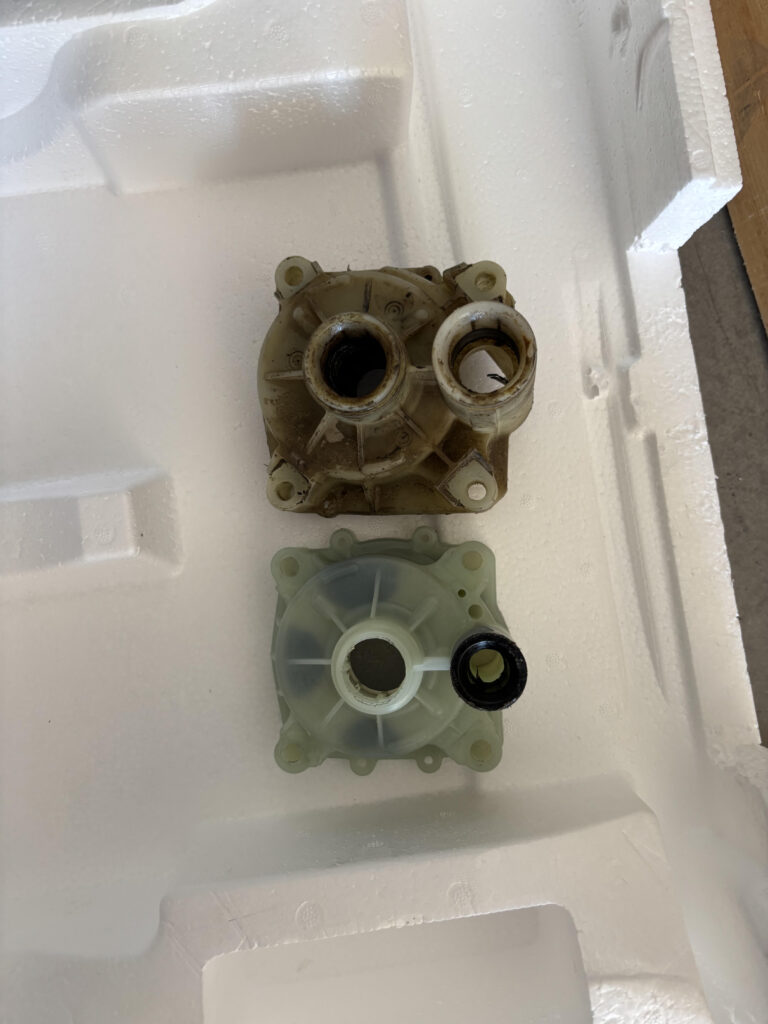
This situation is very common when replacing OEM Yamaha lower units with aftermarket gearcases.
Visual differences can be worrying at first, but they often have simple technical explanations.
Should a customer remove the water pump on a brand‑new unit?
Service videos and manuals show full water pump removal and rebuild as part of regular maintenance on existing lower units.
Typically, the workflow is: drop the old gearcase, remove the pump housing, replace the impeller, reassemble, and reinstall the same unit.
That procedure is maintenance, not the starting point for a brand‑new aftermarket unit.
On a new replacement lower unit, proper practice is usually:
- Bolt the new lower unit onto the engine
- Connect shift linkage and check gear engagement
- Fill with fresh gear oil
- Start the engine and verify strong tell‑tale water flow
Only later, at the next scheduled service interval, would you remove the pump housing to inspect or replace the impeller, just as you would on any OEM Yamaha gearcase.
