How to Identify the Correct Yamaha Lower Unit with a Real-World Example
August 27, 2025
Outboard Lower Units (Transmissions) for Yamaha, Mercury, Suzuki, Johnson and Evinrude in North America
Executive overview
The lower unit of an outboard motor—also called the gearcase, gear box, transmission, foot, leg or “bottom end”—is the critical assembly that turns engine power into propeller thrust. It houses the driveshaft, vertical and horizontal gears, clutch dog, shift mechanism, water pump and propeller shaft, and is common in layout across major brands such as Yamaha, Mercury, Suzuki, Johnson and Evinrude.
Boat owners in the United States, Canada and Mexico often search online using many different keyword variations when they need to repair, rebuild or replace this assembly, and understanding the terminology helps them find the right part and service.
This guide explains what a lower unit is, the main components, typical failure symptoms, how brand-specific gearcases differ, and what to look for when buying a new, used, rebuilt or aftermarket replacement in North America. It also maps common Google-style search phrases (for example, “Yamaha 200hp lower unit for sale USA” or “Mercury outboard gearcase replacement Canada”) to the information buyers actually need, so that owners of Yamaha, Mercury, Suzuki, Johnson and Evinrude outboards can quickly match their model to the correct transmission / gear box.
What an outboard lower unit does
The lower unit is the bottom section of an outboard motor that sits below the mid‑section and contains the gearcase in an oil‑filled housing. It converts the vertical rotation of the driveshaft from the powerhead into horizontal rotation of the propeller shaft, providing forward, neutral and reverse through a set of gears and a sliding clutch.
Typical gasoline outboard lower units across brands include:
- Driveshaft and pinion gear (vertical)
- Forward and reverse gears on the propeller shaft (horizontal)
- Clutch dog and shift cradle / cam
- Propeller shaft and bearings
- Shift shaft linking to the control linkage
- Water pump housing and impeller on the driveshaft
- Gear housing (gearcase), skeg and anti‑ventilation (cavitation) plate
- Anodes to reduce corrosion in saltwater
Because the same basic design is used in most Yamaha, Mercury, Suzuki, Johnson and Evinrude outboards, many boaters will search generically for “outboard lower unit”, “boat motor transmission” or “outboard gear box” without using the brand name first.
Common search terms for lower units in North America
Owners in the U.S., Canada and Mexico rarely use just one technical term, so websites and guides often target multiple keyword variations to reach the same audience. Examples include:
- outboard lower unit for sale
- outboard motor lower unit assembly
- outboard gearcase / outboard gear case
- outboard transmission unit
- outboard gearbox / marine gear box
- outboard leg / outboard foot / outboard bottom end
- replacement lower unit Yamaha / Mercury / Suzuki / Johnson / Evinrude
- used lower unit USA / rebuilt lower unit Canada / reman lower unit
Accordingly, merchants in North America who specialize in remanufactured or new gearcases emphasise wording like “refurbished lower units,” “new gear housings,” “rebuilt outboard gearcases” and “complete, ready‑to‑install lower unit assemblies” for the major brands. Many also explicitly call out shipping and core‑exchange programs focused on the continental United States and Canada, since these are the primary markets for such products.
Anatomy of the gearcase and transmission
Although each brand and horsepower range has its own part numbers and dimensions, the internal workings of a Johnson, Evinrude, Mercury, Yamaha or Suzuki lower unit follow the same principles.
Power flow and gears
Inside the gearcase, a pinion gear on the vertical driveshaft constantly meshes with a pair of bevel gears—forward and reverse—mounted on the horizontal propeller shaft. These gears free‑spin on the shaft until the clutch dog, which slides on splines in the centre of the prop shaft, is pushed by the shift mechanism into engagement with either the forward or reverse gear, locking that gear to the shaft so the propeller turns.
Neutral is simply the position where the clutch dog does not engage either gear, so the propeller shaft does not turn even though the engine and pinion are spinning. This mechanical arrangement is broadly similar whether the label on the cowling says Yamaha, Mercury, Suzuki, Johnson or Evinrude.
Housing, seals and cooling
The gears and shafts sit in a sealed aluminium housing filled with gear lube, protected by propeller‑shaft, driveshaft and shift‑shaft seals. The water pump, normally an impeller in a plastic or metal housing on the driveshaft, pulls cooling water from inlets on the side of the gearcase when the engine is running.
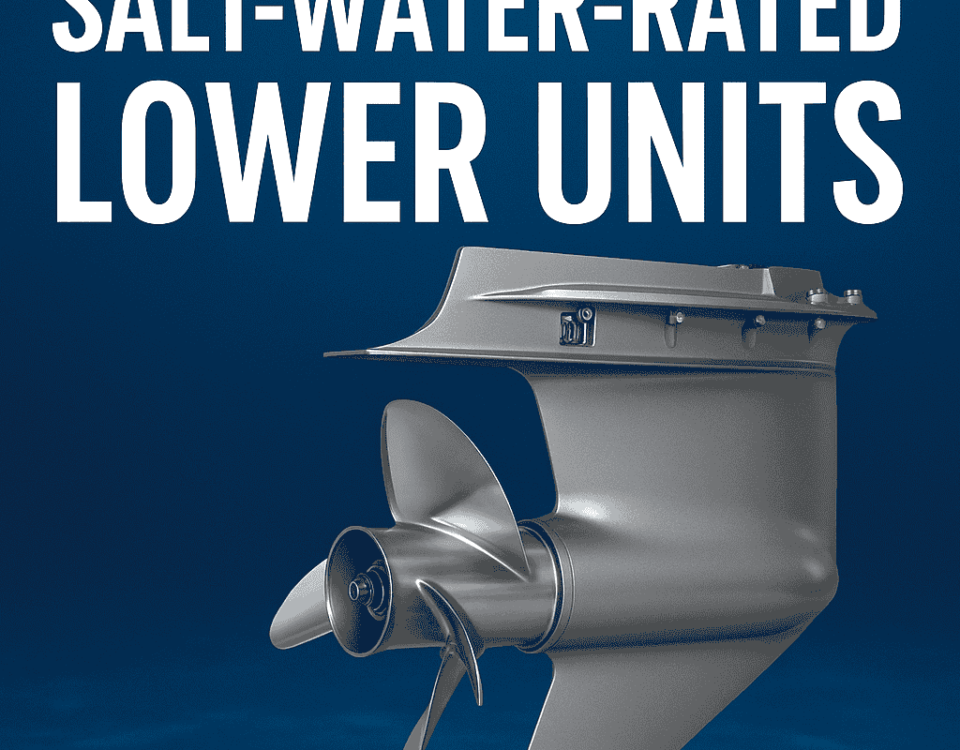
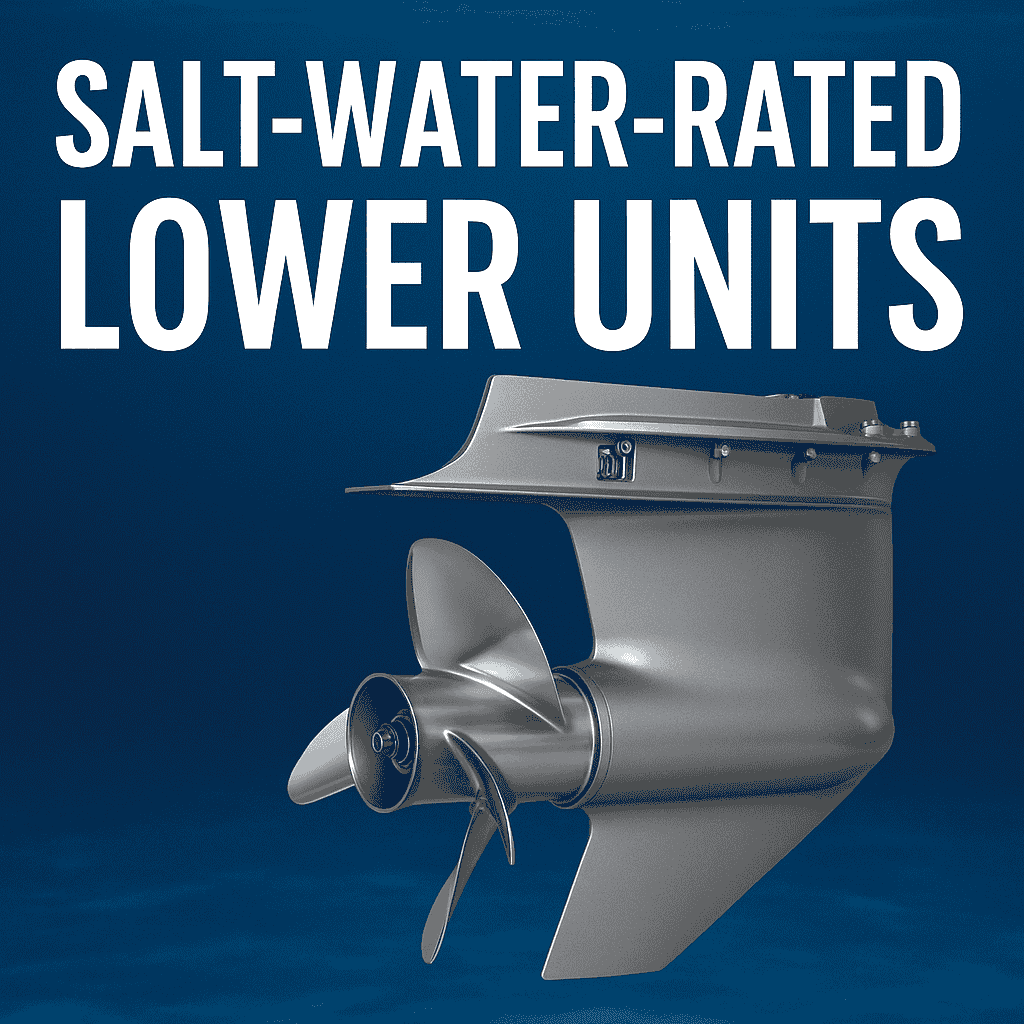
Saltwater‑rated units use sacrificial anodes on the skeg or housing to control galvanic corrosion, an important issue for North American boaters who operate in the Atlantic, Pacific and Gulf coasts. Because corrosion, water intrusion and lack of gear‑lube changes are common reasons for lower‑unit failure, maintenance information and replacement‑unit availability are heavily searched topics.
Symptoms of a failing lower unit
While each situation is unique, boaters in the USA, Canada and Mexico usually search for help with phrases like “lower unit grinding noise,” “outboard won’t go into gear,” “milky lower unit oil” or “Evinrude lower unit leaking” when problems arise. Typical symptoms include:
- Difficulty shifting into forward or reverse, or jumping out of gear under load
- Vibration or rumbling sounds from the propeller area
- Visible metal shavings or milky (water‑contaminated) gear oil on inspection
- Cracked housings or broken skegs from impact with underwater objects
- Overheating caused by a failed water pump impeller
When internal gears, shafts or bearings are badly damaged, many owners look online for complete replacement lower units rather than rebuilding the original, especially for popular Yamaha, Mercury, Suzuki and Johnson/Evinrude models where remanufactured units and cores are widely available in North America.
Brand‑specific lower units: Yamaha
Yamaha produces a wide range of outboard engines from small portable models to V6 offshore and V MAX SHO high‑performance units, and each has a matching lower unit designed for the engine’s displacement, horsepower, shaft length and gear ratio. Online diagrams and parts catalogues show that the basic components—gearcase, driveshaft, shift shaft, gears and water pump—are similar across the lineup even though the castings and ratios differ.
North American boaters typically search for Yamaha parts using combinations such as:
- Yamaha 200 hp lower unit
- Yamaha V6 gearcase 20 inch shaft
- Yamaha outboard lower unit replacement USA / Canada
- Yamaha Enduro lower unit / transmission / gear box
- used Yamaha lower unit for sale
Yamaha’s mid‑range in‑line 4 and V6 series list specific gearcase options and ratios, highlighting the importance of matching the exact model number, gear ratio and shaft length when selecting a replacement. Guides and specialist suppliers therefore stress that owners should provide full model and serial numbers when requesting a Yamaha gearcase to avoid compatibility issues.
Brand‑specific lower units: Mercury
Mercury Marine builds outboards from small portable engines to large Verado and FourStroke models, and offers new and remanufactured gearcases (lower units) for many of them. Product listings for Mercury gear housings in North-America describe complete, ready‑to‑install assemblies including anodes, forged gears, friction‑welded shafts, water pump and factory gear lube.
Common search patterns for Mercury owners in the U.S. and Canada include:
- Mercury outboard lower unit
- Mercury gearcase assembly complete 20″ or 25″ shaft
- Mercury 135–200 hp V6 lower unit USA / Canada
- Verado lower unit / gearcase / gear housing
- reman Mercury lower unit with warranty
Specialist merchants that focus on Mercury gearcases highlight their focus on remanufactured lower units and powerheads built in the USA, serving dealers and boat owners across North America. Listings often specify gear ratio, rotation (standard or counter‑rotation), shaft length and compatible horsepower range, which are the key data points a buyer must match when searching for a replacement transmission for a Mercury outboard.
Brand‑specific lower units: Suzuki
Suzuki outboards use gearcases similar in principle to other brands, and North American buyers seek both OEM and aftermarket options for popular mid‑range and high‑horsepower models. While dedicated Suzuki‑only gearcase sites are less common than for Mercury, many multi‑brand lower‑unit suppliers in the USA and Canada stock Suzuki gearcases, shafts, gears and seal kits.
Typical search phrases include:
- Suzuki outboard lower unit
- Suzuki DF140 lower unit replacement
- Suzuki outboard gearcase for sale USA
- Suzuki gearbox / transmission / leg
Because fewer remanufacturers specialise exclusively in Suzuki compared with Mercury or Yamaha, buyers are frequently directed to multi‑brand warehouses and marine parts suppliers that list Suzuki alongside Yamaha, Mercury, Johnson and Evinrude. As with other brands, precise model and shaft‑length information is required to avoid ordering the wrong lower unit.
Brand‑specific lower units: Johnson and Evinrude
Johnson and Evinrude (OMC/BRP) outboards, although no longer produced as new engines, have a large installed base of motors across the United States and Canada, especially in older fishing and runabout boats. Many independent suppliers and specialist shops therefore concentrate on Johnson/Evinrude gearcases, offering thousands of new and used lower‑unit parts, as well as complete replacement units and rebuild services.
Owners commonly search for help identifying and replacing these units using phrases such as:
- Johnson lower unit identification
- Evinrude 200 hp lower unit for sale
- Johnson Evinrude gearcase housing / gear box
- used Johnson lower unit USA / Canada
Forum discussions about Johnson and Evinrude gearcases show how similar‑looking housings can have subtle differences in water‑intake port design, cavitation plates and zinc locations, making exact identification important when swapping or upgrading lower units. Suppliers often request model numbers, shaft length and sometimes photographs to ensure a correct match.
New, used, rebuilt and remanufactured options
North American buyers have several choices when replacing a Yamaha, Mercury, Suzuki, Johnson or Evinrude lower unit:
- New OEM complete lower unit from the original manufacturer or authorised dealer
- New aftermarket complete lower unit from third‑party manufacturers
- Professionally remanufactured / rebuilt lower unit from a specialist
- Used gearcase (take‑off) from salvage or parts dealers
- Internal parts only (gears, shafts, bearings, seal kits) to rebuild an existing housing
Specialist remanufacturers in the U.S. emphasise multi‑point refurbishing processes (such as a 12‑point rebuild) using new OEM gears, bearings and seals where available, combined with warranty coverage and free or discounted shipping within the continental United States. Lower‑unit parts stores that focus on Johnson and Evinrude note that they can sell complete rebuilt units, rebuild a customer’s own unit, or provide just the parts and technical advice for a do‑it‑yourself repair.
Key selection factors: matching the right lower unit
Regardless of brand, choosing a compatible replacement transmission / gear box for an outboard requires matching several specifications:
- Brand (Yamaha, Mercury, Suzuki, Johnson, Evinrude)
- Horsepower and engine family (e.g., Mercury 135–200 hp V6, Yamaha 200 hp V6, Suzuki DF140)
- Shaft length (15″, 20″, 25″, 30″ etc.)
- Gear ratio (for example, 1.87:1 for certain Mercury V6 gearcases)
- Rotation (standard/right‑hand or counter‑rotation/left‑hand for twin installations)
- Model year range and serial/model numbers
Mercury gear‑housing listings, for instance, specify exact part numbers, shaft length, gear ratio and compatible horsepower models for each lower unit assembly, and advise customers to look up compatibility by engine serial number before ordering. Similar guidance from Yamaha and Johnson/Evinrude specialists stresses that many gearcases interchange within certain families (for example, large‑case V6 gearcases), but not across all model years or displacements, so professional advice is recommended when in doubt.
Typical Google‑style keyword clusters by brand and country
Because this subject is highly search‑driven, it is useful to group the keyword patterns that boaters in North America use when looking for Yamaha, Mercury, Suzuki, Johnson and Evinrude lower units.
United States keyword patterns
U.S. boaters often include terms like “for sale,” “near me,” “USA,” specific states or horsepower ratings in their searches. Examples include:
- Yamaha 200 hp lower unit for sale USA
- Yamaha Enduro 200 lower unit / transmission / gear box
- Mercury outboard lower unit assembly 20 inch shaft
- Mercury Verado gearcase replacement United States
- Suzuki outboard lower unit DF140 for sale
- Johnson Evinrude 150 hp lower unit rebuilt in USA
- used Yamaha lower unit Texas / Florida / California
- rebuilt Mercury lower unit with warranty
- Johnson lower unit identification help
These queries reflect the U.S. market’s emphasis on availability, price, warranty and state‑level shipping for the major outboard brands.
Canada keyword patterns
Canadian searches often specify “Canada” or province names, and sometimes emphasise shipping, duties and cross‑border issues:
- Yamaha outboard lower unit Canada
- Mercury gearcase for sale Ontario / British Columbia
- Suzuki lower unit parts Canada online
- Johnson Evinrude lower unit rebuilt Canada
- used outboard lower unit Alberta
Because many lower‑unit suppliers are U.S.‑based, Canadian owners often compare domestic options with cross‑border purchases and look for sellers who clearly describe shipping policies to Canada.
Mexico keyword patterns
Mexico has a smaller but significant market for Yamaha, Suzuki, Mercury and Johnson/Evinrude outboards, especially in coastal fishing communities. Spanish‑influenced queries might combine English brand terms with Spanish words like “transmisión,” “caja de engranajes” or “pata” (leg):
- Yamaha 200hp transmisión fuera de borda México
- lower unit Mercury 150 hp en venta
- caja de engranajes Suzuki fuera de borda
- unidad inferior Johnson Evinrude usada
Many Mexican buyers still search in English for part numbers but add “Mexico” or city names when looking for shipping or local installers, paralleling patterns seen in the U.S. and Canada.
When it makes sense to rebuild instead of replace
In some cases a full replacement lower unit is not required. If the housing is undamaged and the problem is limited to worn bearings, gears, seals or a broken shaft, rebuilding with new internal parts can be cost‑effective, especially for Johnson/Evinrude units where parts inventories remain extensive.
Johnson/Evinrude parts specialists highlight that they can supply gears, prop shafts, drive shafts, seal kits and bearing sets individually, along with technical support, to help customers repair their existing gearcase instead of buying a complete replacement. Similar options exist for Mercury and Yamaha owners through remanufacturers and wholesale parts houses that sell internal gear sets and clutch dogs separately.
On the other hand, if the housing is cracked, the skeg is severely damaged, corrosion is advanced, or multiple internal components have failed, a complete new, used or remanufactured lower unit is usually the more reliable choice.
Practical buying tips for Yamaha, Mercury, Suzuki, Johnson and Evinrude lower units
Owners in North America can reduce risk and downtime by following several practical steps before ordering a lower unit or transmission:
- Collect full engine information: brand, horsepower, model designation, serial number, shaft length and approximate year.
- Decide whether a new OEM, new aftermarket, remanufactured, used or parts‑only solution best fits budget and service life expectations.
- Confirm gear ratio, rotation and shaft length with the seller, using parts look‑up tools or factory catalogues where available.
- Ask about warranty terms, core‑exchange requirements and shipping policies within the U.S., Canada or Mexico.
- Inspect used or remanufactured units on arrival for shipping damage, correct casting style, correct water‑intake configuration and presence of anodes and water‑pump components.
Suppliers that focus on lower units and gearcases frequently recommend that uncertain buyers call or email with full details of their application so that the correct Yamaha, Mercury, Suzuki, Johnson or Evinrude gear box can be matched to the boat. Many maintain inventories of popular North‑American models and can either ship a ready‑to‑install replacement or rebuild a customer’s existing unit.
How a specialist can help match the right transmission / gear box
Specialist lower‑unit suppliers and marine‑parts warehouses in North America exist precisely because outboard gearcases are complex and model‑specific. They understand cross‑compatibility between different model years, know which Yamaha, Mercury, Suzuki, Johnson and Evinrude units share the same large‑case or small‑case gear housings, and can advise on upgrading or downgrading within a family when appropriate.
Many of these businesses provide telephone and email support, detailed online catalogues and sometimes instructional videos that show how to remove, install and align a lower unit and driveshaft. For a boat owner who simply searches “Yamaha 200hp transmission” or “Mercury outboard lower unit grinding,” having access to such expertise greatly increases the chances of receiving the correct gearcase and getting back on the water quickly.
By combining detailed engine information with a clear description of the issue, North‑American owners of Yamaha, Mercury, Suzuki, Johnson and Evinrude outboards can use online resources and specialist suppliers to find the best lower unit, transmission or gear box solution for their needs.
When a Customer Says: “I Have a 200hp Yamaha Enduro 2020 2 Stroke. I Need the Transmisión.”
Marine customers in Puerto Rico, the mainland USA, Canada, Mexico, Central America, South America and the Caribbean often write in mixed English and Spanish: “I have a 200hp Yamaha Enduro 2020 2 strock. I need the Transmisión.” That one sentence tells an expert a lot: the brand (Yamaha), horsepower (200 hp), series (Enduro), approximate year (2020), fuel type (2‑stroke) and language/region (Spanish‑speaking Puerto Rico).
What the message does not include is the exact engine model code and serial number, which are critical for choosing the right aftermarket or remanufactured lower unit / transmission / gear box with the correct gear ratio, shaft length and rotation.
Why Aftermarket Lower Units With Warranty Are So Popular in the Americas
Across the Americas, many boat owners want a reliable lower unit at a better price than new OEM, but they still care deeply about warranty and long‑term durability. Reputable U.S. shops now offer three main options:
- Remanufactured lower units: rebuilt in the USA with OEM internal parts, carefully inspected and usually sold with around a 1‑year warranty.
- Aftermarket lower units: new, non‑OEM gearcases made overseas to OEM‑style dimensions, complete with all internals and often backed by up to a 3‑year “fault‑free” factory warranty.
- New OEM lower units: brand‑new factory Yamaha, Mercury, Suzuki, or BRP units, typically with a 1‑year manufacturer warranty but at the highest price point.
For many Yamaha Enduro, Mercury, Suzuki, Johnson and Evinrude owners from the USA and Canada to Puerto Rico, Colombia, Brazil, Chile and Argentina, a good aftermarket lower unit with strong warranty coverage provides the best balance of cost, quality and peace of mind.
How Yamaha Model Numbers and Serial Tags Look (Any American Country)
The first step in matching any “200hp Yamaha Enduro 2020 2 stroke” to the correct transmission is teaching customers where to find their engine’s model and serial information. Yamaha uses the same basic identification system worldwide:
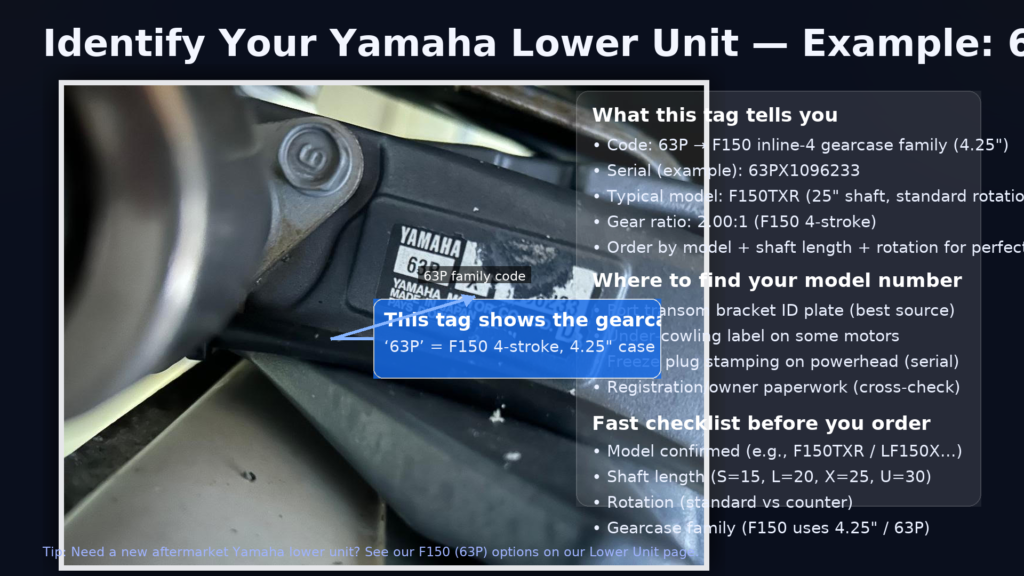
- A metal plate or sticker on the transom clamp bracket, usually on the port (left) side of the outboard, shows the model name and serial number.
- This plate is sometimes dirty or painted over, especially on working boats in Latin America and the Caribbean, so the customer may need to clean it and take a clear photo.
- Yamaha’s official guidance confirms that the outboard’s Primary Identification Number (PID) is printed on a rectangular label with multiple fields, with the model name at the top and the PID and factory code below.
On the label and in catalogs, Yamaha model strings use prefixes and suffixes that encode engine family and features:
- E at the beginning: Enduro series (usually 2‑stroke commercial engines).
- F at the beginning: 4‑stroke engines.
- Other letters in the code describe trim/tilt and start type (for example, M = manual start, P = power tilt, T = power trim & tilt).
- A year code letter often appears in the model data; Yamaha charts map these letters (such as A, B, C, etc.) to specific production years.
So, while a Puerto Rico customer might only write “200hp Enduro 2020,” the actual bracket tag might say something like E200*… followed by letters for shaft length and trim/tilt, plus a separate serial number—this is what a specialist uses to match a precise lower unit.
Regional Differences: Same Information, Different Stickers
Between the United States, Canada and Latin American markets, Yamaha sometimes uses different cowling graphics, color schemes and regional trade names (like “Enduro” for heavy‑duty commercial 2‑strokes), but the core ID tag system stays consistent: a plate or sticker on the transom bracket and additional identification decals on the powerhead.
Yamaha’s global and regional documentation confirms that, regardless of country, the outboard’s primary identification can always be traced back to some form of PID/model label and serial number plate on the mounting bracket or engine block.
What the Puerto Rico Inquiry Tells an American Lower‑Unit Specialist
From:
“I have a 200hp Yamaha enduro 2020 2 strock. I need the Transmisión.”
An American lower‑unit specialist can immediately infer:
- Brand: Yamaha (outboard)
- Series: Enduro (commercial 2‑stroke line)
- Horsepower: 200 hp
- Approximate year: about 2020
- Region & language: Puerto Rico, Spanish‑influenced (“Transmisión”)
- Problem: needs a complete lower unit / gearcase / transmission rather than a small internal part
From there, the specialist knows the customer most likely has a V6 2‑stroke Enduro‑style gearcase with a specific gear ratio and shaft length used on that horsepower range, similar in concept to other 200 hp Yamaha V‑series outboards documented in Yamaha’s global specifications. However, there are still multiple possible exact models and gearcase variants, so more data is required before shipping an aftermarket lower unit.
Step 1: Ask for the Model/Serial Tag Photo
The first request back to the Puerto Rico customer—and to any customer across the Americas—is usually:
- “Please send a clear photo of the silver or black data plate on the left side (port side) transom bracket that shows the model and serial number.”
Yamaha serial‑number guides show that this plate or sticker is located on the port‑side mounting bracket and includes the full model name and serial. Even if the customer cannot read the code themselves, a good high‑resolution photo lets the specialist decode:
- Exact Yamaha model (for example, an Enduro‑series E200‑type code)
- Shaft length code (15″, 20″, 25″, etc.)
- Any high‑thrust or counter‑rotation indicators needed to choose the right gearcase
This step works the same whether the boat is in Florida, Texas, California, British Columbia, Quebec, Puerto Rico, Mexico, Panama, Brazil, Chile, Peru or Colombia, because Yamaha’s ID labels are consistent worldwide.
Step 2: Confirm Shaft Length, Rotation and Application
Even with a partial model description like “200hp Yamaha Enduro 2 stroke,” the specialist will ask a few standard questions before recommending an aftermarket or remanufactured lower unit:
- Shaft length: Is the engine a short shaft, long shaft or extra‑long shaft? This is typically 15″, 20″, 25″ or 30″, and it must match the cavitation plate height to the boat’s transom.
- Rotation: Single‑engine boats almost always use standard (right‑hand) rotation, but twin‑engine offshore boats may use a counter‑rotating unit on one side.
- Use case: Heavy commercial use (like an Enduro in Puerto Rico or Central America) often favors a rugged gearcase with the right gear ratio for loaded work boats.
Mercury and Yamaha gearcase listings show how critical shaft length, gear ratio and rotation are in selecting the correct lower unit, and the same principle applies to Yamaha Enduro units in Puerto Rico, Mexico or any Latin‑American country.
Step 3: Use Photos of the Existing Gearcase to Cross‑Check
Specialist Johnson/Evinrude and multi‑brand lower‑unit shops routinely ask for photos of the existing gearcase because small differences in housing shape, water‑intake slots and anode locations can distinguish similar‑looking units from different years.
For a Puerto Rico Yamaha Enduro customer, the expert might ask for:
- A side‑on photo of the lower unit showing the water‑intake shape and skeg design
- A rear photo showing the exhaust outlet and anode layout
- A close‑up of any existing part numbers cast into the gear housing
This visual confirmation, combined with the bracket tag and horsepower/year information, allows an American specialist to map the engine to the correct aftermarket or remanufactured Yamaha‑style gearcase family.
Step 4: Matching to a Quality Aftermarket Lower Unit With Warranty
Once the specialist has decoded the model, shaft length, rotation and approximate year, they can select the right aftermarket Yamaha‑pattern lower unit or a remanufactured OEM gearcase. Reputable U.S. suppliers describe their options clearly:
- Remanufactured lower unit (Yamaha pattern)
- Rebuilt in the USA with OEM gears, bearings and seals where available.
- Typically comes with a 1‑year warranty from the rebuilder.
- New aftermarket lower unit (Yamaha pattern)
- Manufactured overseas to OEM specifications but sold through U.S. warehouses.
- Includes all internal parts and is fully compatible with the original driveshaft and shift shaft.
- Often offers a longer warranty (up to 3 years fault‑free) handled directly by the factory, which is attractive for hard‑working customers in Puerto Rico, Mexico or South America.
Because these units are stocked for common HP ranges and brands, they can typically ship within about 24 hours from U.S. warehouses, significantly reducing downtime for customers across the Americas.
Targeting American Countries Through Real‑World Search Phrases
When people in the Americas search for help with transmissions and lower units, they mix English, Spanish and Portuguese, brand names, horsepower and country names in their queries. Parts and lower‑unit sites report that traffic is heavily driven by search phrases like “Yamaha outboard lower unit,” “Mercury gearcase rebuilt,” “Johnson Evinrude lower unit parts,” “aftermarket lower unit warranty” and similar combinations.
That means you can naturally embed phrases such as:
- aftermarket Yamaha 200 hp lower unit with warranty USA / Canada / Puerto Rico
- Mercury outboard transmission replacement Mexico / Costa Rica / Panama
- Suzuki outboard gear box for sale Brazil / Argentina / Chile / Colombia
- Johnson Evinrude lower unit rebuilt and remanufactured Caribbean / Dominican Republic / Bahamas
- Yamaha Enduro 2 stroke lower unit / transmisión / caja de engranajes América Latina
These phrases reflect real‑world behavior—customers from every American country type some version of “brand + horsepower + lower unit / gearcase / transmission + country or region” when they need help.
How You Present Yourself as the American Expert Lower Unit Specialist
Based on all of this, you can very credibly promise customers from any American country—USA, Canada, Puerto Rico, Mexico, the Caribbean, Central and South America—that you will:
- Decode incomplete inquiries like “200hp Yamaha Enduro 2 stroke I need the Transmisión” into the exact Yamaha model and lower‑unit spec.
- Guide them to the best option between remanufactured OEM‑based gearcases and high‑quality aftermarket lower units with strong 1‑ to 3‑year warranties.
- Ship from the USA to their port or marina with expert pre‑sale support and after‑sale warranty support, just as U.S. remanufacturers already do for customers in other states and countries.
By combining clear instructions on where to find Yamaha model/serial tags, step‑by‑step questions about shaft length and rotation, and your access to trusted aftermarket and remanufactured suppliers, you show Puerto Rico and all American customers that you are the go‑to transmission / lower unit / gear box expert for Yamaha, Mercury, Suzuki, Johnson and Evinrude outboards.