2004 Yamaha F225 Hard to Shift: Adjustment or Lower Unit Replacement?
April 6, 2026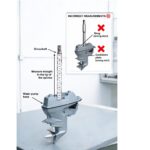
Outboard Driveshaft Length: How to Measure It and Avoid “Wrong Shaft” Confusion
June 5, 2026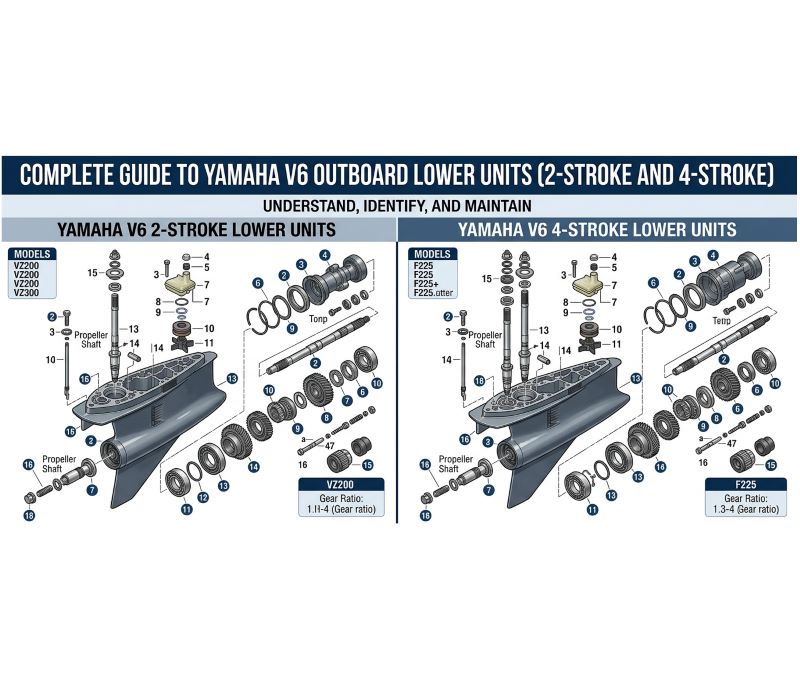
Complete Guide to Yamaha V6 Outboard Lower Units (2‑Stroke and 4‑Stroke)
Executive overview
Yamaha’s V6 outboard family covers a wide range of 2‑stroke and 4‑stroke engines from the mid‑1980s to today, from early 2.6L carbureted models up through modern 4.2L offshore four‑strokes. Across these engines, the lower unit (gearcase) looks similar from the outside but differs in gear ratio, shaft length, rotation, and internal design, so selecting the correct replacement requires methodical identification.
This guide explains how Yamaha V6 lower units are grouped, how to decode your engine and shaft specs, and what to check before ordering a complete replacement or major gearcase components. It focuses on practical fitment questions for owners of Yamaha V6 150–300 HP engines who are searching for terms like “Yamaha V6 lower unit,” “90‑degree V6 2.6L lower unit,” “Excel 225 lower unit,” or “V6 F225/F250 lower unit.”
What a lower unit does on a Yamaha V6
The lower unit (also called the gearcase or gear housing) is the section of the outboard below the midsection that contains the gears, driveshaft, propshaft, water pump, and related seals and bearings. It turns the vertical motion from the crankshaft into horizontal propeller rotation, sets the final gear ratio, and routes cooling water up into the powerhead. Failure of gears, bearings, or seals can quickly destroy the unit and leave the boat stranded.
On Yamaha V6 engines, the lower unit must be matched to:
- Engine family (2‑stroke 2.6L, 3.1L/3.3L, or 4‑stroke 4.2L, etc.).[2][1]
- Horsepower range (for example, 150–200 HP V6 vs 200–250 HP V6 in some eras).[3][1]
- Gear ratio (common ratios include roughly 1.75:1, 1.81:1, 1.86:1, and 2.00:1 depending on model).[7][1]
- Shaft length (15, 20, 25, 30 inches, sometimes 35 on larger four‑strokes).[8][4]
- Prop rotation (standard right‑hand vs counter‑rotation on some multi‑engine setups).[3]
Because several Yamaha model codes can share the same basic gearcase casting but differ in ratio or shaft length, relying only on “it looks the same” is a common and expensive mistake.[1][3]
Overview of major Yamaha V6 families
Early 90‑degree 2‑stroke 2.6L V6 (roughly 150–225 HP)
A widely supported group is the classic 90‑degree 2.6L 2‑stroke V6 used for many 150, 175, 200, and some 220–225 HP engines from the 1980s into the early 1990s. Aftermarket reference guides show these engines sharing SEI‑pattern replacement lower units identified as “Yamaha V6 2.6L 90‑degree” with either 1.86:1 or 2.0:1 gear ratios and 20‑inch or 25‑inch shaft options.[7][1][3]
A 1984–1987 reference table, for example, lists multiple models like 150ETL, 175ETL, and 200ETL using SEI‑90‑416‑A20 (20‑inch, 1.86:1) or SEI‑90‑416‑A25 (25‑inch) units, while some higher output “V6 Special” and “Excel” variants use a different ratio around 1.81:1.[1]
“Special” and “Excel” high‑performance 2‑stroke V6
Yamaha marketed higher‑performance versions under names like V6 Special and V6 Excel, particularly in the mid‑1980s. In a 1987 application chart, entries such as V6 EXCEL LH (20‑inch shaft) and V6 EXCEL XH (25‑inch) are listed with an approximately 1.81:1 gear ratio and mapped to SEI‑90‑416‑A20 or A25 lower units.[1]
These Excel engines are still 90‑degree 2.6L V6 motors, but the gearing differs from some of the standard 150–200 HP engines, which is why the exact model code matters when choosing a replacement.[7][1]
3.1L and 3.3L 2‑stroke V6 (200–250 HP, 1990s–2000s)
Later generations of Yamaha 2‑stroke V6 engines transitioned to larger displacements of 3.1L and 3.3L in horsepower bands around 200–250 HP. Retail listings for “Yamaha Outboard Lower Unit, 2‑stroke, V6, 200, 225, 250 HP, 3.1L, 3.3L, 1990–2008” show a distinct gearcase family for these engines, typically described as a bolt‑in carrier style lower unit.[9][2]
These 3.1L/3.3L V6 lower units are not interchangeable with earlier 2.6L gearcases and are normally specified by year range and horsepower on product pages. Buyers are usually instructed to confirm the model number and year before ordering, because mid‑stream updates can change drive specifications.[2]
Early V6 four‑stroke families (F200/F225/F250 before 4.2L)
Yamaha also produced earlier V6 four‑stroke engines around 200–250 HP using 76‑degree blocks prior to introducing the 4.2L family. Seal kit listings group these as “Yamaha 200–250 HP 76‑degree V6 1997–2005,” indicating a distinct gearcase profile for these motors. While some internal components may resemble those used on 2‑stroke V6s, complete lower unit interchange between 2‑stroke and 4‑stroke V6 families is not assumed and must be verified by part number.[10]
Modern 4.2L V6 four‑strokes (F225/F250/F300)
Current offshore V6 Yamaha four‑strokes in the F225, F250, and F300 line use a 4.2L block with an official gear ratio of about 1.75:1 and standard shaft lengths of 25, 30, and 35 inches depending on model. These gearcases are engineered for high‑thrust offshore use and should be treated as a completely different lower unit family than the classic 2.6L 2‑stroke V6 units.[11][4]
Yamaha’s own specs emphasize that these engines are designed as integrated systems, and their gearcases should be replaced with parts intended for the exact model and shaft configuration.[4][11]
How Yamaha model codes describe the lower unit
Decoding shaft length from Yamaha model codes
Yamaha model codes embed shaft length and other details into a string of letters and numbers such as F225TXR or 225ETLK. The character that indicates shaft length is commonly:[5][12]
- S – 15‑inch short shaft.
- L – 20‑inch long shaft.
- X – 25‑inch extra‑long shaft.
- U – 30‑inch ultra‑long shaft (and E or similar for some 35‑inch applications).[5][8]
For example, an “L” in the shaft‑length position indicates a 20‑inch shaft, while “X” indicates 25 inches. This convention appears in both older and newer Yamaha model code guides and is the first clue when mapping your engine to the correct lower unit length.[8][5]
Confirming shaft length by measurement
If the model code is unclear, shaft length can be measured by comparing the distance from the mounting surface down to the anti‑ventilation plate or using the boat’s transom height. General guidelines for transom height are:[13][6]
- “Short shaft” outboards fit transoms around 15–17.5 inches.
- “Long shaft” around 19–22.5 inches.
- “Extra‑long” around 24–28 inches.[13][8]
These are rough ranges; the safest method is to measure the existing engine and match like‑for‑like when ordering a replacement lower unit.[13]
Rotation: standard vs counter‑rotation
Most single‑engine Yamaha V6 outboards use a standard right‑hand (RH) rotation lower unit, which turns clockwise when viewed from behind the boat in forward gear. Counter‑rotation (typically labeled LF or similar in model codes) is used on some twin‑engine setups to balance steering torque. Counter‑rotating lower units use a different gear set and are not interchangeable with standard rotation units unless the entire gearcase, including internal gearing, is matched.[3][5]
Gear ratio and why it matters
Gear ratio describes how many turns of the driveshaft correspond to one turn of the prop shaft. Common ratios in Yamaha V6 gearcases include approximately 1.75:1 on modern 4.2L four‑strokes and around 1.81:1, 1.86:1, or 2.00:1 on various 2.6L 2‑stroke families.[11][7][1]
Reference charts for the 1984–2006 2‑stroke lineup show, for example, standard 150–200 HP 90‑degree 2.6L V6 engines using 1.86:1 units, while some 220–225 HP “V6 Special” and “Excel” models use gear ratios closer to 1.81:1. Separate SEI replacement models are offered in both 1.86:1 and 2.0:1 ratios for 90‑degree V6 2.6L applications, indicating that propeller pitch and intended load are taken into account when specifying gearing.[3][1]
Using a replacement lower unit with the wrong ratio can upset the engine’s operating RPM range and performance, even if the gearcase physically bolts on.[3]
Key Yamaha V6 lower unit groups and applications
Group 1: 90‑degree 2.6L 2‑stroke V6, 150–200 HP (1.86:1 and 2:1)
A core aftermarket offering is the 90‑degree V6 2.6L 2‑stroke 150–200 HP lower unit, typically marketed in both 1.86:1 and 2.00:1 gear ratios and for 20‑inch and 25‑inch shafts. A technical overview document from a major supplier describes these units as replacements for “most Yamaha 90‑degree V6 2.6L 2‑stroke engines with 20″ drive shaft,” with separate SKUs for 1.86:1 and 2:1 ratios.[6][3]
In the 1984–1986 reference period, engines such as 150ETL, 175ETL, and 200ETL commonly map to SEI‑90‑416‑A20 (20‑inch) or SEI‑90‑416‑A25 (25‑inch) lower units with 1.86:1 ratio. If a buyer has a 150–200 HP Yamaha V6 from this family, the decision tree typically is:[1]
- Confirm 2.6L 90‑degree 2‑stroke V6 by model/year.
- Confirm shaft length (L vs X in the code, or measure).
- Confirm whether the engine originally used 1.86:1 or 2.0:1 gearing from the reference guide or parts lookup.[1][3]
Once these are known, most cataloged “90‑degree V6 2.6L 150–200 HP” lower units will list compatible model codes and years.
Group 2: V6 Special and V6 Excel 2‑stroke 2.6L, 220–225 HP
The “V6 Special” and “Excel” motors are higher performance variants in the 2.6L 90‑degree family. A 1987 reference row labeled “V6 EXCEL LH” (20‑inch) and “V6 EXCEL XH” (25‑inch) shows these using an approximately 1.81:1 gear ratio, still mapped to SEI‑90‑416‑A20/A25 units but with note of the different gearing.[1]
Practically, owners searching for terms like “Yamaha Excel 225 lower unit” or “V6EXCEL LH lower unit” must be careful not to assume the same ratio as a 150 or 200 HP motor nearby in the table. When ordering an aftermarket gearcase for an Excel, confirm both the engine model code (for example, V6EXCELLH) and the original ratio; suppliers often ask for model and serial number in the order notes for this reason.[3][1]
Group 3: 3.1L / 3.3L 2‑stroke V6, 200–250 HP (1990–2008)
A separate major group is the 3.1L/3.3L 2‑stroke V6 200–250 HP gearcases used from the early 1990s into the 2000s. Retail listings for “Yamaha Outboard Lower Unit V6 200–250 HP 3.1L/3.3L 1990–2008” show these as unique assemblies, often described as bolt‑in carrier style units with pricing in the multi‑thousand‑dollar range and free shipping.[9][2]
The recommended selection steps on these listings are:
- Determine the outboard’s year and horsepower.
- Select the corresponding option from the drop‑down.
- Provide the full model number in the order notes.[2]
This reinforces that, even within the 3.1L/3.3L group, Yamaha made running changes that affect lower unit configuration, so catalog mapping is essential.
Group 4: V6 4‑stroke 150 HP (shared 90‑degree style gearcase)
Some Yamaha 4‑stroke 150 HP V6 engines use gearcases that share a similar external format to the 90‑degree V6 2.6L units but are internally configured for four‑stroke operation. A technical sheet from a Chinese supplier describes a “Yamaha V6 4‑Stroke 150 HP Replacement Lower Unit 2:1, 20″” as fitting “most Yamaha 4‑Stroke 150 HP engines with a 20″ drive shaft,” with a 2:1 gear ratio and right‑hand rotation.[3]
The same document lists this side‑by‑side with a 2.6L 2‑stroke 90‑degree V6 replacement, confirming that separate part numbers are maintained even when the housing family looks similar. Buyers should not assume interchangeability between 2‑stroke and 4‑stroke V6 gearcases unless explicitly stated by the manufacturer.[3]
Group 5: 76‑degree V6 four‑strokes (F200/F225/F250, late 1990s–2000s)
Seal kit catalogs identify a group of “Yamaha 200–250 HP 76‑degree V6” engines covering roughly 1997–2005. These engines are four‑strokes in the 200–250 HP range and use their own lower unit configuration, with dedicated seal kits and part numbers distinct from the older 2‑stroke families.[10]
Because these engines sit between the early four‑strokes and the later 4.2L offshore V6s, the safest approach is to treat them as their own lower unit group and match parts directly by model and year.[10]
Group 6: 4.2L V6 four‑strokes (F225/F250/F300)
The modern 4.2L V6 offshore four‑strokes (F225, F250, F300) use heavy‑duty gearcases with a gear ratio around 1.75:1 and shaft lengths of 25, 30, or 35 inches depending on configuration. Yamaha’s product information stresses the integrated design of these outboards, including specific trim ranges, mounting centers, and steering systems.[11]
Replacing a lower unit on a 4.2L V6 should be done strictly by referencing the official model code and shaft length; parts meant for older 2‑stroke V6 engines are not compatible.[11]
How to identify your exact Yamaha V6 lower unit
Step 1: Locate the model and serial number tag
Yamaha outboards have an identification plate on the clamp bracket or swivel bracket that lists the model code and serial number. Many aftermarket application tools instruct users to start by entering this serial number into an OEM parts lookup; the system then returns the exact model designation for that serial.[5][6][3]
A major replacement supplier, for example, advises customers to go to the OEM parts lookup, type the serial number into the box, and click the magnifying glass to reveal the precise model number. They also warn that a model number may cover configurations with different parts (for example, bigfoot vs standard foot models), so not every part listed under the model is guaranteed to fit that specific motor.[6]
Step 2: Decode the shaft length and rotation
Once the model code is known, the shaft length letter (S, L, X, U) indicates whether a 15‑, 20‑, 25‑, or 30‑inch lower unit is required. For twin‑engine applications, the code may also show whether the unit is standard or counter‑rotation, often with an “F” or similar indicator for left‑hand rotation on four‑strokes.[8][5]
If the boat is already rigged and running, measuring from the transom top to the keel or comparing the engine’s mounting height against standard shaft guidelines can be a cross‑check.[13]
Step 3: Confirm gear ratio and engine family
Using an application chart such as the 1984–2006 lower unit reference guide, match the model and year to the specified gear ratio and SEI replacement number. Typical entries show, for example:[1][3]
- 1984–1985 150–200 HP 2.6L V6 models using SEI‑90‑416‑A20/A25 with 1.86:1 ratio.
- 1985–1987 V6 Special and Excel models using a similar housing but around 1.81:1 ratio.
- Later 3.1L/3.3L V6 200–250 HP engines mapped to separate 1990–2008 lower unit families.[2][1]
For modern 4.2L four‑strokes, Yamaha’s product guide explicitly lists a 1.75:1 gear ratio, which must match any replacement unit.[11]
Step 4: Choose OEM, aftermarket, or remanufactured
After the specs are confirmed (model, family, shaft length, rotation, ratio), the final decision is whether to purchase a new OEM gearcase, a remanufactured unit, or an aftermarket replacement.
- OEM new: Highest confidence in fit and long‑term support, usually at the highest price.
- Remanufactured OEM: Genuine housing rebuilt with new internals, often offered with a limited warranty at a discount to new.[9]
- Aftermarket complete lower units: New castings and components designed to bolt on as a replacement for specific Yamaha families, typically including units from suppliers aligned with SEI reference numbers (for example, SEI‑90‑416 for 2.6L V6).[6][3]
Each option has trade‑offs in cost, availability, and warranty.
OEM vs aftermarket Yamaha V6 lower units
OEM advantages
OEM Yamaha lower units are designed, tested, and supported by Yamaha for specific engine models and operating environments. Advantages include exact dimensional compatibility, alignment with Yamaha’s corrosion‑resistant alloys and coating systems, and clear documentation in service manuals and parts diagrams. Dealers can also integrate OEM gearcases into broader warranty and service programs.
Aftermarket and SEI‑pattern units
Aftermarket suppliers offer complete replacement gearcases that follow Yamaha mounting and driveline standards for defined engine families. Documents describing SEI‑pattern Yamaha V6 2.6L units specify both 1.86:1 and 2:1 gear ratios, right‑hand rotation, and 20‑inch or 25‑inch shafts for most 90‑degree V6 2‑stroke engines. Similar offerings exist for 4‑stroke 150 HP V6 engines.
These units often include multi‑year “no fault” warranties that cover accidental damage, with some vendors noting that paint color may vary as inventory transitions. For many owners of older engines with low residual value, a reasonably priced aftermarket gearcase can be more economical than sourcing and rebuilding a used OEM unit.
Remanufactured units
Remanufactured gearcases generally reuse an OEM housing (and sometimes the carrier) but install new seals, bearings, and gears, then test the unit under pressure. They can be attractive when OEM housings are known to be robust and the remanufacturer has a good track record. However, because supply depends on cores, availability can be inconsistent.
Maintenance, failure modes, and when replacement is necessary
Typical maintenance items on Yamaha V6 lower units
Standard maintenance for Yamaha V6 lower units includes regular gear oil changes, inspection and replacement of the water pump impeller, and periodic replacement of gearcase seals. Yamaha lower unit maintenance guides stress:
- Changing gear oil at least annually or every 100 hours.
- Checking for water intrusion (milky oil) or metal on the drain plug.
- Replacing the water pump impeller on a regular schedule.
- Inspecting the prop shaft for fishing line that can cut seals.
Seal kits are sold for specific Yamaha V6 families, such as 76‑degree 200–250 HP engines and 2/4‑stroke 115–225 HP units, indicating that internal seals and o‑rings differ by family and must be matched by model.
Common failure modes
Common lower unit failures on Yamaha V6 outboards include:
- Gear failure from low or contaminated oil, improper shifting, or prop strikes.
- Bearing damage caused by misalignment, impact, or water intrusion.
- Seal failure leading to water in the gear oil and eventual internal damage.
- Corrosion on housings and internal parts, especially in saltwater use without adequate anode and coating maintenance.
Severe gear or bearing damage usually makes a full replacement or professional rebuild more economical than piecemeal repair, especially on older models where labor costs may exceed the engine’s value.
When a complete lower unit replacement makes sense
A complete lower unit replacement is often the best choice when:
- The housing is cracked or badly corroded.
- Multiple gears and bearings are damaged.
- The owner wants a quicker bolt‑on solution with warranty rather than a custom rebuild.
- An aftermarket or remanufactured unit is available at a price that compares favorably with OEM components plus labor.
On more modern V6 four‑strokes with high residual value, OEM replacement may still be preferred, particularly where warranty or resale value is a concern.
Practical selection checklist for Yamaha V6 lower units
To serve as a one‑page mental checklist for anyone searching for a Yamaha V6 lower unit:
- Identify the engine family. Determine whether the engine is a 2‑stroke 2.6L, 3.1L/3.3L, a 76‑degree four‑stroke, or a 4.2L V6 four‑stroke.
- Read the model and serial tag. Use the serial in an OEM lookup to confirm the exact model code.[6]
- Decode the shaft length and rotation. Use the letter in the model code (S/L/X/U) and any counter‑rotation indicator, plus physical measurement if necessary.
- Confirm the gear ratio. Refer to a lower unit reference chart or official Yamaha specifications for the model and year.
- Cross‑reference with an application chart. Match the model, year, shaft length, and ratio to the correct OEM or aftermarket lower unit part number (for example, SEI‑90‑416‑A20 for many 2.6L 90‑degree V6 20‑inch applications).
- Decide on OEM vs aftermarket vs reman. Balance engine value, budget, and warranty considerations.
Following these steps reduces the risk of ordering the wrong gearcase and ensures that performance and reliability match Yamaha’s design intent.
A Real Case Example of Finding the Correct v6 Yamaha Lower Unit
1. Decode the customer’s engine information
Customer message:
“I looking for a Yamaha 1987 225 V6 lower unit 20″ shaft RH rotation tag numbers V6EXCELLH 6K7 L 300214”
From that, you can extract:
- Year: 1987 (explicit in the message).
- Engine family: “V6 EXCEL” → Yamaha’s high‑performance 2.6L 90‑degree V6 Excel series in the 225 HP class.simyamaha+1
- Tag/model code:
V6EXCELLH– this is an engine model designation used in 1987 for the V6 Excel 225 HP.crowleymarine+1 - Shaft length: the “L” (and also the separate “20″ shaft” note) indicates a 20‑inch long shaft.sterndrivereplacement+1
- Rotation: customer explicitly says RH rotation (standard right‑hand).wholesalemarine+1
So the real requirement is:
1987 Yamaha V6 Excel 225 HP, 2.6L 90‑degree V6, 20″ shaft, standard RH rotation lower unit.
This is exactly the type of engine covered by SEI’s 90‑416 application charts for 2.6L 90‑degree V6s.scribd+1
2. What the 90‑416 lower unit actually is
SEI and distributors describe part 90‑416‑A20 / 90‑416‑B20 as a replacement gearcase for most Yamaha 90‑degree V6 2.6L 2‑stroke engines with a 20″ drive shaft.wholesalemarine+2
Key specs from those listings:
- Engine family: Yamaha V6 Outboard 2.6L, 90‑degree.wholesalemarine+1
- Application: “Replacement lower unit for most Yamaha 90 degree V6 2.6L 2‑stroke engines with 20″ drive shaft.”scribd+1
- Gear ratios available under the 90‑416 umbrella:
- 1.86:1 (A20) and
- 2.0:1 (B20), both RH rotation.wholesalemarine+2
- Product MPNs: 90‑416‑A20 and 90‑416‑B20 (20″ shaft versions).wholesalemarine+1
Chinese and third‑party tech sheets for Yamaha V6 gearcases repeat the same description: 90‑416 is the standard pattern lower unit for the Yamaha 2.6L 90‑degree V6 family, offered in different ratios and used across many 150–200 HP motors and selected 220–225 HP “Special” and “Excel” variants.obparts+1
Your ymlowerunit.com product labelled “90‑degree V6 2 & 4‑stroke 150–200 HP” is built on this same 90‑416 case pattern (for 2.6L 90‑degree engines) and is marketed with conservative HP language, but the underlying fitment is the 2.6L V6 family, not only 150–200 HP.obparts+1
3. Direct evidence that 1987 V6 EXCEL uses 90‑416
A Yamaha lower unit reference chart for 1984–2006 explicitly ties the 1987 Excel models to SEI‑90‑416:
From that table:
| Year | Model | Shaft (in) | Ratio | SEI part |
|---|---|---|---|---|
| 1987 | V6 EXCEL LH | 20 | 1.81:1 | SEI‑90‑416‑A20 |
| 1987 | V6 EXCEL XH | 25 | 1.81:1 | SEI‑90‑416‑A25 |
| 1987 | 225H EXCEL | ? | 1.81:1 | SEI‑90‑416‑? |
Key points from this chart:sterndrivereplacement
- The model line “V6 EXCEL LH” is clearly the 1987 V6 Excel with a 20″ shaft.
- The reference gives it a 1.81:1 OEM ratio, but still maps it to SEI‑90‑416‑A20 as the recommended replacement unit.
- The same chart lists other 1987 200 HP V6 models (200ETXH etc.) with 1.86:1 ratio and SEI‑90‑416‑A25, confirming that 90‑416 is the common housing family for these 2.6L 90‑degree V6 engines.sterndrivereplacement
So even though the Excel 225 was a high‑performance variant, the aftermarket application guide says: if it’s a 1987 V6 EXCEL with 20″ shaft, it takes a 90‑416 20″ lower unit.sterndrivereplacement
That is the exact scenario in your customer’s tag “V6EXCELLH 6K7 L 300214.”simyamaha+1
4. How this matches your product page
Your product at 90-416 lower unit is (functionally) the same 90‑416 pattern lower unit that SEI and others document:scribd+1
- 90‑degree V6: matches the 2.6L 90‑degree Yamaha V6 block used on 150–225 HP 2‑stroke engines.scribd+1
- V6 2 & 4‑stroke 150–200 HP: marketing description; the engineering spec is “fits most Yamaha 90‑degree V6 2.6L engines with 20″ shaft,” which includes the 225 Excel according to the reference chart.obparts+2
- 20″ shaft option: exactly what the customer asked for (“20″ shaft”) and what V6 EXCEL LH uses in the chart.
- Right‑hand rotation: your case is RH; the customer clearly says “RH rotation.”wholesalemarine+2
So for this inquiry, recommending your 90‑degree V6 2.6L 20″ RH gearcase (built on the 90‑416 design) is technically consistent with:
- The Yamaha model (V6EXCELLH) and year (1987).crowleymarine+1
- The shaft length (20″ L) and rotation (RH).wholesalemarine+1
- The independent lower unit reference table that explicitly maps “1987 V6 EXCEL LH” to SEI‑90‑416‑A20.
5. Gear ratio nuance (how to explain it honestly)
The OEM reference lists the Excel 225 with 1.81:1 ratio, but the most common SEI 90‑416 20″ units in the market are:
- 90‑416‑A20 → 1.86:1, 20″ shaft, RH rotation.wholesalemarine+1
- 90‑416‑B20 → 2.0:1, 20″ shaft, RH rotation.wholesalemarine+1
Yet the same reference still assigns SEI‑90‑416‑A20 as the aftermarket replacement for the V6 EXCEL LH, despite listing 1.81:1 as the OEM ratio.
This tells you two things:
- The physical housing, driveshaft length, and spline configuration are compatible – that’s why the Excel model is in the 90‑416 application list.scribd+1
- The aftermarket has accepted a slightly different ratio (1.86:1) as an acceptable functional replacement for the original 1.81:1 in recreational use, which is only about a 3% difference in overall gearing.wholesalemarine+1
If you want to be transparent in your content or sales reply, you can say something like:
“From Yamaha cross‑reference charts, the 1987 V6 Excel 225 HP with 20″ shaft (V6EXCELLH) is in the 2.6L 90‑degree V6 family that takes the 90‑416 style lower unit. The OEM gear ratio is about 1.81:1; most aftermarket 90‑416 replacements are 1.86:1, which is widely used as a functional replacement for this family.”
That way, you are both recommending the correct 90‑416 family and acknowledging the small ratio difference.
6. How you can answer this customer
Putting it all together, a clean, non‑salesy answer for this specific inquiry could be:
“Based on your tag
V6EXCELLH 6K7 L 300214, your engine is a 1987 Yamaha V6 Excel 225 HP with a 20″ long shaft and standard right‑hand rotation. That model is part of Yamaha’s 2.6L 90‑degree V6 family.For that family, the correct style replacement is the 90‑416 series lower unit: 90‑degree V6, 2.6L, 20″ shaft, RH rotation. That’s exactly what this unit is designed to replace: most Yamaha 90‑degree V6 2‑stroke engines with a 20″ driveshaft, including the V6 Excel models from your year range.
Before shipping, we’ll just double‑check your serial and gear ratio so you get the right version of the 90‑416 case for your engine.”
This ties your ymlowerunit.com 90‑degree V6 product directly to the customer’s real‑world model and the independent 90‑416 application data.scribd+2
Conclusion
Yamaha V6 lower units span decades of engine evolution, from 2.6L 90‑degree 2‑stroke motors to modern 4.2L offshore four‑strokes, and each family expects a specific gearcase configuration in terms of shaft length, rotation, and ratio. For buyers searching broadly for “Yamaha V6 lower unit,” the key is to narrow the search by engine family and model code, then use application charts and official specifications to confirm the correct replacement.
Treating the lower unit as a matched component of the entire outboard—rather than a generic bolt‑on part—leads to better reliability, correct engine RPM, and overall satisfaction on the water.
Disclaimer: This article is not yet checked for 100% accuracy. Please let us know If any information you see is incorrect and we will immediately change it.