Yamaha F250NCA: Identify and Source the Correct Lower Unit
June 9, 2026
How to Select the Correct Johnson/Evinrude Lower Unit
July 17, 2026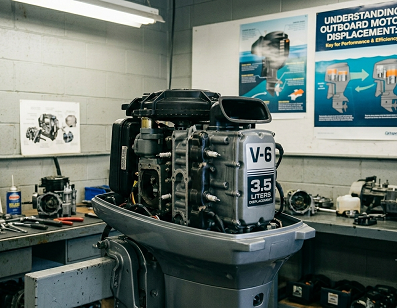
Engine size (often called displacement) is the total volume swept by all pistons in the motor. It’s usually measured in cubic centimeters (cc) or liters. In simple terms, engine size = bore² × stroke × number of cylinders. Larger displacement means more air/fuel mix per cycle, which generally yields more power and torque. For example, a 3.35L V6 has about 3352 cc of cylinder volume. Displacement is a key spec: it’s one of the main “engine size” measures used in advertising and fitment.
Motor manufacturers often label engines by horsepower (e.g. 250 HP), but different engines can make that same HP with different displacements. That’s why “250HP” alone doesn’t uniquely define the engine’s size or parts. Two 250HP engines might have very different cylinders. In Yamaha’s case, the older 250HP model (F250H) was a 3.352L V6 four-stroke, while the new 2023 F250 is a 4.2L V6. The table below highlights how Yamaha 250HP engines vary:
- 3.35L V6 (60°) – Yamaha F250H/FL250H (introduced ~2016). Displacement = 3352 cm³.
- 4.2L V6 (60°) – Yamaha F250 (2023 model). Displacement = 4169 cm³ (4.2 L).
Figure: Yamaha 250HP outboard engine (2023 model, 4.2L V6). Knowing the engine’s displacement and model is important when selecting parts (lower units, driveshafts, etc.).
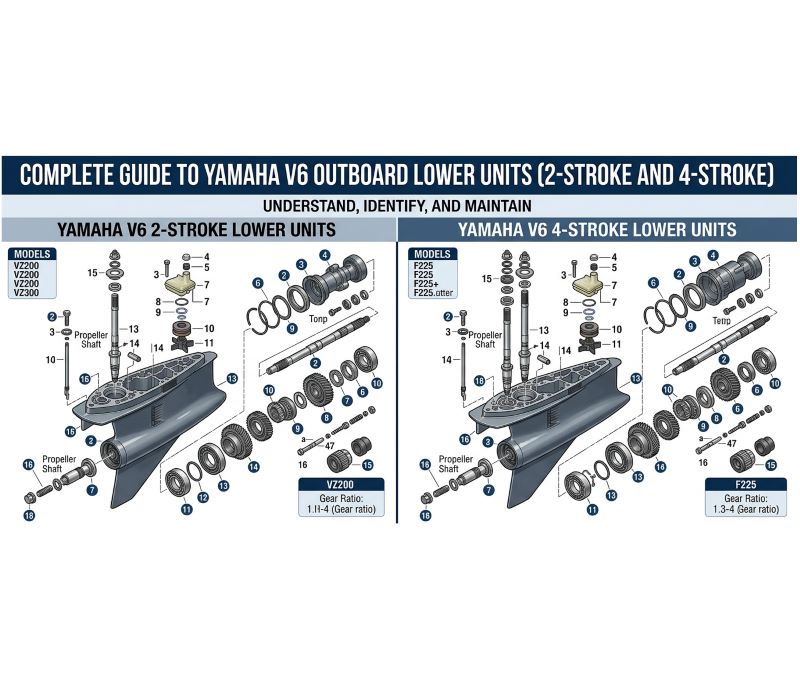
Because of this, parts vendors always need the engine size and model when you order a lower unit or driveshaft. Yamaha’s 250HP engines use different gears and shafts depending on displacement. For example, the new 4.2L F250 has a gear ratio of 1.75:1 (and shaft length options X=25″, U=30″, etc.), whereas the older 3.35L F250 used a 1.86:1 ratio. Even small changes in cylinder volume or rotation can mean different lower-unit parts. As Pro Marine notes, “Yamaha used multiple lower unit configurations depending on shaft length, rotation, and production year. Always verify fitment using your model and serial number.”. In short, “engine size” here means the specific displacement (cc/L) and design of the 250HP motor, not just its horsepower. The vendor asked “engine size” to make sure they send a lower unit matching that exact engine variant.
Why Displacement Matters for Power and Parts
Engine displacement directly affects performance. More cubic centimeters mean more room for the air-fuel mix, which translates to higher torque and power potential. That’s why high-horsepower outboards usually have larger engines. For example, Yamaha’s V6 4.2L 250HP produces far more low-end torque than smaller engines, giving faster acceleration. It also means the engine is physically larger – more cylinders or bigger cylinders – which can require a differently-designed gearcase and driveshaft length. In practice, this means you cannot substitute a lower unit from one engine size into another, even at the same HP. The driveshaft spline count, oil passages, and gear arrangement can differ. For instance, Facebook forums note that using a 3.35L lower unit on a 4.2L motor can leave the driveshaft half an inch out of engagement.
Yamaha’s parts guides reflect this. The 4.2L F250 parts manual lists a 25.3″ (X) drive shaft for the regular-rotation model. The new F250 also offers multiple shaft lengths (25″, 30″, 35″) depending on code. If you supply only “250HP” and not the displacement or model code, a vendor cannot be sure which driveshaft or gearcase you need. That’s why specifying engine size is crucial: it ties the HP rating to a particular engine design, ensuring the correct lower unit and shafts are shipped. In summary, engine size (displacement) determines which internal parts fit, and mismatches can cause severe damage.
Yamaha 250HP Outboard Variants
Yamaha’s 250HP four-stroke outboards have evolved through different engine sizes. Key variants include:
- Older F250 (F250H, etc.) – 3.352L V6 (24-valve, 60° V6). This engine (used roughly 2017–2022) displaces 3352 cc. It produces 250 HP @5500 RPM and has a 1.86:1 gear ratio. Its driveshaft length (code “X”) is 25.3″. Lower units for this engine are different than the newer series.
- New F250 (2023+) – 4.2L V6 (24-valve, 60° V6). Introduced in 2023, this engine has 4169 cc displacement and also makes 250 HP @5500 RPM. It has a 1.75:1 gear ratio. Shaft lengths X=25″, U=30″, etc., are listed for this model.
- Yamaha VMAX SHO 250 (4.2L V6). Yamaha’s high-performance SHO version also uses a 4.2L V6 (250HP) but with performance tuning. Its lower unit is similar to the new F250’s.
- Different rotation: Yamaha also makes a counter-rotation version (left-hand rotation) of the 250HP V6. Counter-rotation lower units have different part numbers (e.g. Yamaha LF250XA, etc.) but use the same 4.2L or 3.35L powerheads.
These differences mean that telling your parts vendor “250HP” isn’t enough. You must also give the model code or engine size. For example, the code F250HETX decodes to F250H (3.35L V6), Electric start, Tall shaft, 25″ X-length. The vendor uses this info to pick the matching lower unit.
Why Vendors Ask About Engine Size
Parts sellers ask for engine size because fitment depends on it. Two engines rated 250HP can have different cylinder volume, bore/stroke, and number of cylinders – all of which affect the design of the drive shaft, gear set, and midsection. In practical terms:
- Gear Ratio & Torque: A larger displacement engine usually has a different gear ratio for its lower unit. As noted above, Yamaha’s 4.2L 250HP uses 1.75:1, while the 3.35L version uses 1.86:1. The gear ratio change means the gear set itself (and prop performance) is different.
- Drive Shaft Length: Even a small difference in block size can change how far the shaft must protrude. Yamaha’s parts diagrams show a 25.3″ shaft for F250HETX versus the option of 25″ or 30″ on the new model.
- Mounting and Seals: The lower unit must mate precisely with the midsection and engine block. Bolt patterns, oil seals and O-rings may vary with engine version. Vendors use engine size to ensure the replacement seals and gaskets are correct.
- Warranty and Support: Using the wrong lower unit can ruin both the gearcase and powerhead. By confirming engine size, vendors protect you (and themselves) from a costly mistake.
In short, the vendor asked “what is the engine size?” to confirm whether you have the 3.35L or 4.2L variant (or some other version) of the 250HP Yamaha. This guarantees they send a fully compatible lower unit and driveshaft assembly for that specific engine.
Common Outboard Engine Sizes
Outboard engines span a wide range of displacements, typically growing with horsepower. Here are some common examples (Yamaha models) for context:
- 25–75 HP: ~1.8L or less (e.g. Yamaha F90/F75 are ~1.8L, 90–75HP).
- 115–150 HP: ~2.0–2.8L inline-4 (e.g. F150 is 2.8L i4, F115 is 1.8L i4).
- 150–200 HP: ~2.8L inline-4 (Yamaha F200 is 2.8L i4).
- 200–225 HP: 3.352L V6 (older F225 and F200 V6 models).
- 225–250 HP: Either 3.352L V6 (F225/F250 older series) or 4.2L V6 (new F250/F300 series).
- 300 HP: 4.2L V6 (Yamaha F300).
- 350 HP: 4.3L V6 (Yamaha F350).
- 400–450 HP: 5.6L V8 (Yamaha XTO 400/425/450 series, not shown).
Each jump in horsepower tends to use a bigger displacement or more cylinders. For example, the F350’s 4.3L V6 can generate more top-end power than the F300’s 4.2L. Always check the engine’s model code and specs. For the 250HP class, this means paying attention to whether it’s the 3.35L or 4.2L version.
Takeaway: “Engine size” on an outboard means the actual displacement of that engine’s cylinders. It must match the part you order. When you tell a vendor “250HP Yamaha, 25″ shaft,” also give the engine’s model or cc (e.g. “F250H 3352cc V6”). This ensures the lower unit, driveshaft, and seals you receive will fit exactly – avoiding costly mismatches.
Outboard Engine Sizes by Brand: Yamaha, Mercury, Suzuki, Honda, Tohatsu and Evinrude
When boat owners search for a lower unit, they often focus on horsepower. A customer may say they own a 250 HP outboard and need a replacement gearcase. However, professional marine suppliers know that horsepower alone is not enough.
Different manufacturers build multiple engine families. Two engines with the same horsepower may have different engine sizes, gear ratios, driveshaft lengths, shift shafts, and lower unit designs.
That is why marine parts suppliers often ask for the engine model number, serial number, model year, and engine size before recommending a replacement lower unit.
Yamaha Outboard Engine Sizes
Yamaha has produced several engine families over the years.
For example, Yamaha has offered 250 HP outboards based on different engine platforms. Some 250 HP models were built on the 3.3-liter V6 platform, while newer models use Yamaha’s 4.2-liter V6 platform.
Because these engines use different components, a lower unit from one platform may not fit the other.
Popular Yamaha engine families include:
- Inline 4-cylinder platforms
- V6 platforms
- V8 XTO Offshore platforms
When ordering Yamaha lower units, customers should provide:
- Full model number
- Model year
- Serial number
- Shaft length
- Rotation type (standard or counter-rotation)
Mercury Outboard Engine Sizes
Mercury has produced many different engine platforms over the years.
A 250 HP Mercury Verado may use a completely different powerhead and lower unit design than another Mercury 250 HP model from a different generation.
Mercury engines may be found in:
- Inline 4-cylinder configurations
- Inline 6-cylinder configurations
- V6 configurations
- V8 configurations
Because Mercury has multiple generations of Verado and FourStroke engines, suppliers normally request the serial number before recommending a lower unit.
Suzuki Outboard Engine Sizes
Suzuki is known for producing large-displacement four-stroke outboards.
Many Suzuki engines share components across horsepower ranges, but there are still significant differences between engine families.
Common Suzuki platforms include:
- Inline 3-cylinder engines
- Inline 4-cylinder engines
- V6 engines
When ordering Suzuki lower units, always provide:
- Model number
- Serial number
- Year
- Shaft length
Honda Outboard Engine Sizes
Honda outboards are built around several engine families that often share technology with Honda automotive engines.
Honda engines are available in:
- Twin-cylinder configurations
- Inline 3-cylinder configurations
- Inline 4-cylinder configurations
- V6 configurations
Even when horsepower ratings are similar, Honda may use different gearcases depending on the engine family and production year.
Tohatsu Outboard Engine Sizes
Tohatsu manufactures outboards under its own brand and has supplied engines for other marine brands throughout its history.
Tohatsu offers:
- Portable single-cylinder engines
- Twin-cylinder engines
- Inline 3-cylinder engines
- Inline 4-cylinder engines
As with other manufacturers, lower unit compatibility depends on the exact engine platform rather than horsepower alone.
Evinrude Outboard Engine Sizes
Although Evinrude production ended in 2020, many boats still use Evinrude engines today.
Evinrude engines include:
- Two-stroke carbureted models
- Direct-injection E-TEC models
- V4 engines
- V6 engines
Replacement lower units and rebuild kits often depend on the exact Evinrude engine family and gearcase design.
Why Engine Size Matters
Engine size affects:
- Torque output
- Gear ratio requirements
- Driveshaft design
- Shift shaft design
- Water pump components
- Lower unit compatibility
This is why professional suppliers ask detailed questions before recommending replacement parts.
The more information you provide, the better chance you receive the correct lower unit the first time.
Why Suppliers Ask for Engine Size When You Provide an International Model Number
Many customers are surprised when they provide a Yamaha model number such as F250HETX and the supplier still asks for engine size.
The reason is simple.
International model numbers are not always as easy for US suppliers to decode.
Marine parts suppliers in the United States work primarily with North American model codes and serial number databases. Some international models use naming conventions that differ from US catalog systems.
For example, a customer may provide:
F250HETX
A supplier may recognize that it is a Yamaha 250 HP outboard, but they may not immediately know which engine platform it belongs to without checking additional information.
The supplier wants to determine:
- Which engine family is being used
- Which lower unit was installed from the factory
- Which driveshaft length is required
- Which gear ratio is correct
- Whether the engine uses standard or counter rotation
Asking for engine size helps narrow down those possibilities.
Why US Model Numbers Often Do Not Require Engine Size
When a customer provides a US model number such as F115TXR along with the model year, many suppliers can immediately identify the engine through their catalog systems.
The model number often links directly to:
- Engine family
- Gearcase type
- Shaft length
- Rotation
- OEM parts breakdown
Because the supplier already knows the exact engine platform, there is usually no need to ask additional questions about engine size.
The Best Information to Provide
To avoid delays, customers should always provide:
- Full model number
- Model year
- Serial number
- Shaft length
- Standard or counter rotation
- Photos of the identification tag if available
This information allows suppliers to recommend the correct lower unit, gearcase, electrical part, rebuild kit, or driveshaft with confidence.
Frequently Asked Questions
What does engine size mean on an outboard motor?
Engine size refers to engine displacement. It is usually measured in cubic centimeters (cc) or liters (L). It represents the total volume of all cylinders in the engine.
Is engine size the same as horsepower?
No.
Horsepower measures engine output. Engine size measures displacement. Two engines can have the same horsepower but different engine sizes.
Why does my supplier need engine size for a lower unit?
The lower unit may vary between engine families. Engine size helps confirm compatibility.
Can two 250 HP outboards use different lower units?
Yes.
Different engine platforms can use different gearcases, driveshafts, and gear ratios even when horsepower is identical.
What information should I provide when ordering a lower unit?
Provide:
- Model number
- Serial number
- Model year
- Shaft length
- Rotation type
This is usually enough to identify the correct replacement.
What is shaft length?
Shaft length is the distance between the engine mounting bracket and the cavitation plate. Common lengths include 20-inch, 25-inch and 30-inch models.
What is counter rotation?
Counter-rotation engines turn the propeller opposite to standard rotation. Twin-engine boats often use one standard-rotation engine and one counter-rotation engine.
Can I identify a lower unit using horsepower only?
No.
Horsepower alone is not enough to guarantee compatibility.
What if I cannot find my model number?
Send clear photos of:
- The engine identification tag
- The serial number plate
- The existing lower unit
A marine parts specialist can often identify the correct parts from those photos.
Where can I buy aftermarket lower units?
YMLowerUnit.com supplies aftermarket and rebuilt lower units, gearcases, driveshafts, electrical components, and replacement marine parts for many popular outboard brands.
Frequently Asked Questions
What does engine size mean on an outboard motor?
Engine size refers to engine displacement. It is usually measured in cubic centimeters (cc) or liters (L). It represents the total volume of all cylinders in the engine.
Is engine size the same as horsepower?
No.
Horsepower measures engine output. Engine size measures displacement. Two engines can have the same horsepower but different engine sizes.
Why does my supplier need engine size for a lower unit?
The lower unit may vary between engine families. Engine size helps confirm compatibility.
Can two 250 HP outboards use different lower units?
Yes.
Different engine platforms can use different gearcases, driveshafts, and gear ratios even when horsepower is identical.
What information should I provide when ordering a lower unit?
Provide:
- Model number
- Serial number
- Model year
- Shaft length
- Rotation type
This is usually enough to identify the correct replacement.
What is shaft length?
Shaft length is the distance between the engine mounting bracket and the cavitation plate. Common lengths include 20-inch, 25-inch and 30-inch models.
What is counter rotation?
Counter-rotation engines turn the propeller opposite to standard rotation. Twin-engine boats often use one standard-rotation engine and one counter-rotation engine.
Can I identify a lower unit using horsepower only?
No.
Horsepower alone is not enough to guarantee compatibility.
What if I cannot find my model number?
Send clear photos of:
- The engine identification tag
- The serial number plate
- The existing lower unit
A marine parts specialist can often identify the correct parts from those photos.
Where can I buy aftermarket lower units?
YMLowerUnit.com helps you order aftermarket and rebuilt lower units, gearcases, driveshafts, electrical components, and replacement marine parts for many popular outboard brands.